
Wilhelm Röntgen: the man who let us see inside the human body
- Remembering his discovery of X-rays on the evening of 8 November 1895 at the University of Würzburg.
- He received the first Nobel Prize in Physics in 1901.
- His discovery opened the era of medical imaging, from fracture X-rays to CT scans.
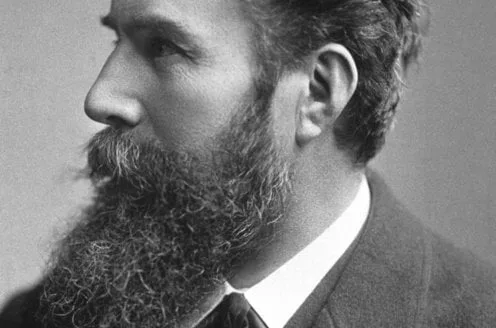
This week we remember German physicist Wilhelm Conrad Röntgen, who on the evening of 8 November 1895 discovered a new kind of radiation. He called it “X-rays” because its nature was unknown; it is also known as Röntgen radiation.
Early life
Röntgen was born on 27 March 1845 in Lennep, Germany (now part of Remscheid), and grew up in the Netherlands. He studied at ETH Zurich, earned his doctorate in physics at the University of Zurich, and worked at the universities of Strasbourg, Giessen and Würzburg.
Also read: Frederick Sanger: the scientist who decoded insulin and paved the way to reading genes
The discovery
While studying cathode rays in a partly evacuated glass tube, he noticed that a light-sensitive screen nearby began to glow even though the tube was covered. His experiments showed the cause was a new, penetrating type of radiation.
Impact on medicine
X-rays quickly became a way to look inside the body without surgery, revealing fractures and foreign objects, and later led to techniques such as computed tomography. In 1901 Röntgen received the first Nobel Prize in Physics and donated the prize money to his university.
He died on 10 February 1923 in Munich.
Sources: NobelPrize.org, University of Würzburg
This story is relayed from the source named above; responsibility for its content rests with the original source.
FAQ
Who was Wilhelm Röntgen?
Wilhelm Röntgen (1845–1923) was a German physicist who discovered X-rays in 1895 and received the first Nobel Prize in Physics in 1901.
When did Röntgen discover X-rays?
Röntgen discovered X-rays on the evening of 8 November 1895 at the University of Würzburg, Germany.
Why are they called X-rays?
Röntgen called them X-rays because their nature was unknown, using X as the symbol for the unknown.
How did X-rays change medicine?
X-rays allowed doctors to see inside the body without surgery, revealing fractures and foreign objects, and led to CT scanning.
Did Röntgen win a Nobel Prize?
Yes. Röntgen received the first Nobel Prize in Physics in 1901 for discovering X-rays.