
Abu Bakr al-Razi: the physician who told smallpox from measles and dared to question Galen
- Abu Bakr Muhammad ibn Zakariya al-Razi (865–925) was one of the greatest physicians of the Islamic world and ran hospitals in Rayy and Baghdad.
- His celebrated treatise set smallpox apart from measles, and his students compiled his vast notes into the Comprehensive Book.
- He revered Galen, yet wrote Doubts about Galen where his own observations disagreed.
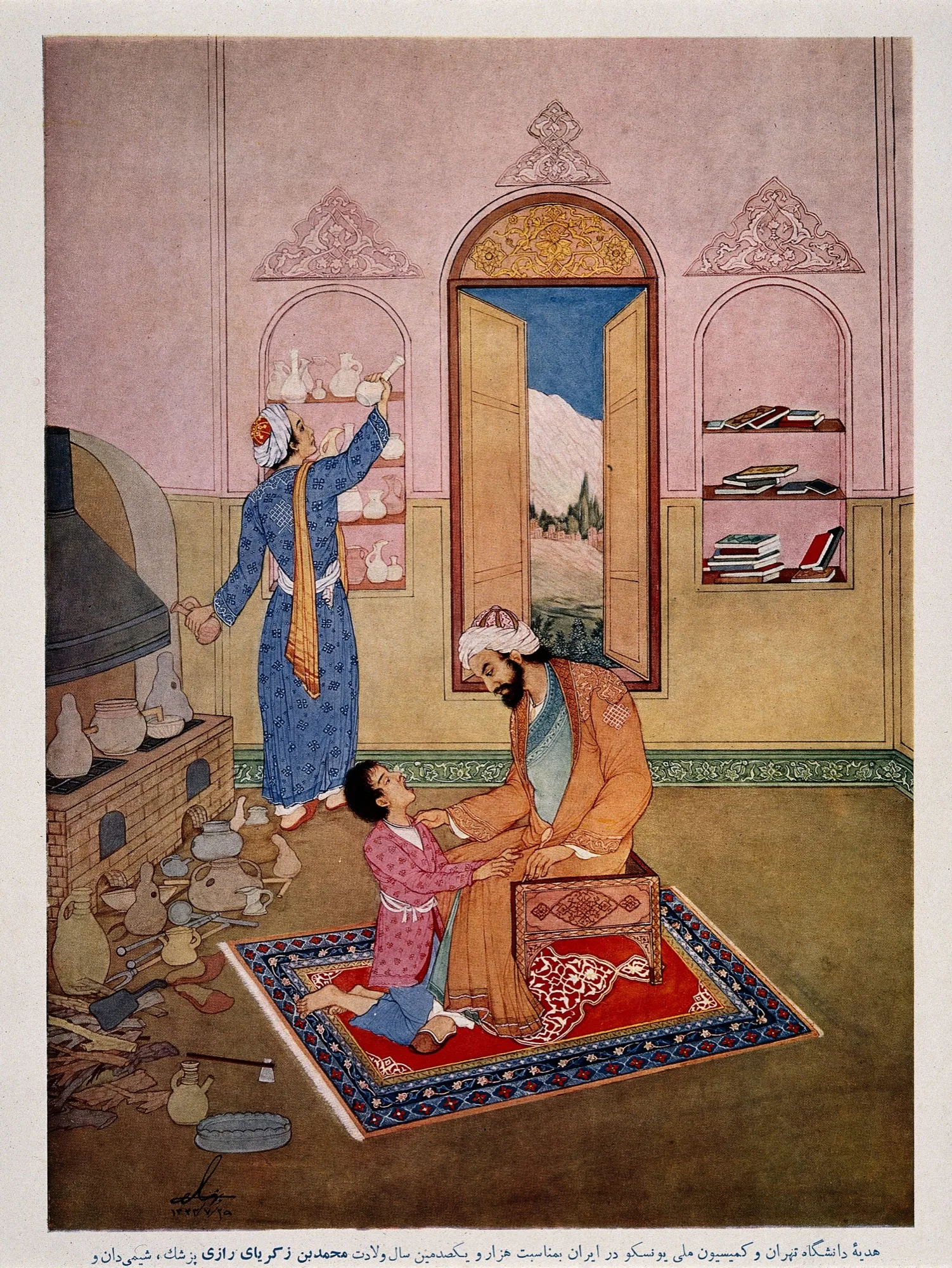
Abu Bakr Muhammad ibn Zakariya al-Razi, known in medieval Europe as Rhazes, was born in 865 in the Persian city of Rayy, near today's Tehran, which gave him his name. He made his fame above all as a doctor: his biographers say he ran a hospital in Rayy and another in Baghdad. He died in 925 and is still ranked among the greatest figures in the history of medicine in the Islamic tradition.
A doctor who wrote down what he saw
All his life al-Razi collected notes on his patients and on what earlier authorities had written, using his own observations to confirm or reject inherited theories. After his death his students gathered these papers into an enormous work, the Comprehensive Book (al-Hawi), translated into Latin in 1279 as the Continens and consulted by European doctors for centuries.
He dedicated a substantial medical treatise to Abu Salih al-Mansur, governor of Rayy, known as the Book for al-Mansur, and wrote a guide for people with no doctor at hand.
Smallpox is not measles
His most famous short work is the treatise on smallpox and measles, which describes the two diseases and separates them by signs a physician can see, at a time when many rashes were lumped together. It was translated into Latin and later into several European languages, including an English edition in the 19th century.
Doubts about Galen
Al-Razi considered Galen the greatest of medical authorities, but reasoned that Galen himself had criticised his predecessors, so he could do the same. In Doubts about Galen he took issue with points that clashed with what he had observed, a bold step at a time when Galen's word was close to unquestionable.
Later biographers tell a well-known story, impossible to verify, that he chose the site of a Baghdad hospital by hanging pieces of meat in different districts and picking the spot where they spoiled most slowly. Al-Razi himself tells us that endless reading, copying and writing strained his eyes and injured his hand.
Why he still matters
Testing medical claims against observation, and recording what actually happens to patients, is the core of today's evidence-based medicine. More than eleven centuries on, al-Razi remains one of the first to teach doctors to trust what they see as much as what they read.
Sources: Stanford Encyclopedia of Philosophy — Abu Bakr al-Razi, Encyclopaedia Britannica — al-Razi
This story is relayed from the source named above; responsibility for its content rests with the original source.
FAQ
Who was Abu Bakr al-Razi?
Abu Bakr Muhammad ibn Zakariya al-Razi (Rhazes) was a Persian physician and philosopher (865–925), born in Rayy near modern Tehran, who ran hospitals in Rayy and Baghdad.
What are al-Razi's most important medical books?
Al-Razi's most important medical books are the Comprehensive Book (al-Hawi), compiled from his notes by his students, the Book for al-Mansur, the treatise on smallpox and measles, and Doubts about Galen.
What did al-Razi contribute on smallpox and measles?
In his treatise on smallpox and measles, al-Razi described both diseases and distinguished them by clinical signs; the work was translated into Latin and several European languages.
Why did al-Razi write Doubts about Galen?
Al-Razi wrote Doubts about Galen because, while he revered Galen, some of Galen's claims conflicted with his own observations, and he argued against them on that basis.