Charles Scott Sherrington, the Nobel laureate who gave us the word "synapse"
- The British neurophysiologist Charles Scott Sherrington was born on 27 November 1857.
- Sherrington coined the word "synapse" for the connection between two neurons.
- Sherrington summed up his work in The Integrative Action of the Nervous System (1906) and shared the 1932 Nobel Prize in Physiology or Medicine with Edgar Adrian.
- Three of Sherrington's Oxford students went on to win Nobel Prizes, including Howard Florey.
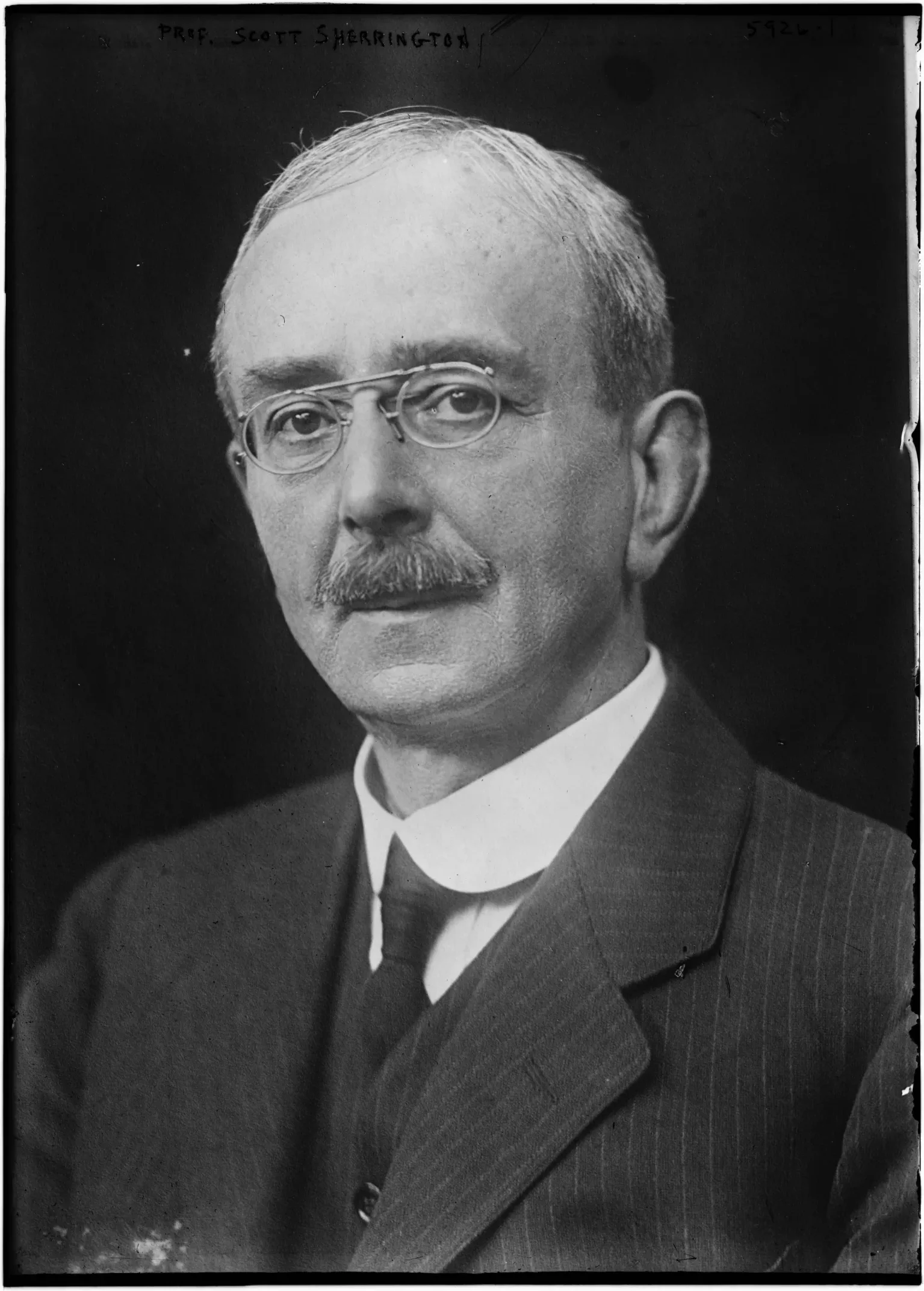
On this day, 27 November 1857, Charles Scott Sherrington was born in London. Neuroscience owes him one of its best-known words: when he needed a name for the point where two nerve cells meet, he coined "synapse".
How reflexes really work
Sherrington showed that the spinal reflex is a system of connected neurons, and that signals passing between them can be strengthened or damped down. He also described reciprocal innervation: when one muscle contracts, its opposite number relaxes, which is what makes our movements smooth. He brought it all together in The Integrative Action of the Nervous System in 1906.
Also read: Born on this day: Andrew Huxley, who showed how nerves carry their signals
A Nobel Prize and a school of laureates
He held chairs of physiology in Liverpool and then Oxford, was president of the Royal Society in the early 1920s and shared the 1932 Nobel Prize in Physiology or Medicine with Edgar Adrian. Three of his Oxford students, John Eccles, Ragnar Granit and Howard Florey, later won Nobel Prizes too, and he steered the future neurosurgeon Wilder Penfield towards the brain.
The next generation took the story further, among them Andrew Huxley, who showed how nerves carry their signals. Sherrington died on 4 March 1952, aged 94, his mind clear to the end.
Sources: The Nobel Prize: Charles Sherrington, biographical, Wikipedia: Charles Scott Sherrington
This story is relayed from the source named above; responsibility for its content rests with the original source.
FAQ
Who was Charles Sherrington?
Charles Scott Sherrington (1857–1952) was a British neurophysiologist who helped found modern neuroscience and shared the 1932 Nobel Prize in Physiology or Medicine.
Did Sherrington invent the word synapse?
Yes, Charles Sherrington coined the word synapse to describe the connection where a signal passes from one neuron to another.
What is reciprocal innervation?
Reciprocal innervation, described by Charles Sherrington, means that when one muscle contracts its opposing muscle relaxes, allowing smooth movement.
When did Sherrington win the Nobel Prize?
Charles Sherrington shared the 1932 Nobel Prize in Physiology or Medicine with Edgar Adrian for discoveries about the function of neurons.
What is Sherrington's best-known book?
Charles Sherrington's best-known book is The Integrative Action of the Nervous System (1906), which brought together his research on reflexes and neurons.